

Skip to content
Contact Us
الميزان دوت نت للمحاسبة والمستودعات
  • Home
  • About the Software
    • About Us
    • Our Clients
  • Products
  • Services
  • Learning
    • Knowledge Base
    • Video Tutorials
  • Blog
  • Downloads
    • Al Mizan .NET
    • Updates
    • Utilities
  • العربية
  • Home
  • About the Software
    • About Us
    • Our Clients
  • Products
  • Services
  • Learning
    • Knowledge Base
    • Video Tutorials
  • Blog
  • Downloads
    • Al Mizan .NET
    • Updates
    • Utilities
  • العربية
  • Home
  • About the Software
    • About Us
    • Our Clients
  • Products
  • Services
  • Learning
    • Knowledge Base
    • Video Tutorials
  • Blog
  • Downloads
    • Al Mizan .NET
    • Updates
    • Utilities
  • العربية

User Guide

  • Knowledge Base
  • Accounting Menu
    • Chart of Accounts and Account Cards in Al Mizan
    • Define Customer and Supplier Records
    • Budgets and Their Uses
    • Account-Specific Analysis in Al Mizan
    • Transfer Account Transactions in Al Mizan
    • Account Analysis: General Analysis
    • Allocation Accounts in Al Mizan
    • Aggregate Accounts
    • Allocate Accounts to Cost Centers
    • Closing Accounts in Al Mizan
  • Accounting Reports
    • Receivables and Payables Aging Report in Al Mizan
    • Customer Balances Report in Al Mizan
    • Customer Statement Report in Al Mizan
    • General Ledger Report in Al Mizan
    • Trial Balance Report in Al Mizan
    • Most Active Customers Report
    • Inactive Customers Report in Al Mizan
    • Journal Daybook Report in Al Mizan
    • Account Transaction Analysis Report in Al Mizan
    • Budget Report
    • Monthly Account Transactions Report
    • Closing Accounts Report in Al Mizan
    • Cost Center Ledger Report
    • Permissions Report: Options and Uses
    • Chart of Accounts Report
  • Archiving
    • Archiving Module in Al Mizan .NET
  • Definitions Menu
    • Invoice Type Settings in Al Mizan
    • Sales Representative Invoice Commissions in Al Mizan
    • Cost Centers in Al Mizan
    • Define Custom Journal Vouchers in Al Mizan
    • Define Commercial Paper Types in Al Mizan
    • Sales Representatives: Journal Entry Commissions
    • Define Branch Records and Configure Their Options
    • Payment Methods in Al Mizan
    • Define the Currency Exchange-Rate Schedule
    • Define Currencies and Configure Their Options
    • Define Bank Records in Al Mizan
    • Define Warehouse Records and Configure Their Options
  • Features
    • Start Page Settings and Panels in Al Mizan
    • Database Rollover in Al Mizan
    • Processing Import Transactions
    • Use Al Mizan Functions in Excel
    • Configure Perpetual Inventory in Al Mizan
    • Define and Use an Item Independent Unit
    • Use Item Subinventory in Invoices
    • Report Toolbar Options
    • Import Items and Accounts from Excel
    • Audit Log: Options and Uses
    • Task List: Options and Uses
    • Design Page and Report Headers and Footers
    • The Calculator in Al Mizan
  • File Menu
    • Delete a Database in Al Mizan
    • Create and Restore a Database Backup
    • Create and Set Up a New Database
    • Attach Database Files
  • Financial Statements
    • Financial Statements in Al Mizan
  • Fixed Assets
    • Fixed Asset Management in Al Mizan
  • Inventory Reports
    • Detailed Invoice Transactions Report
    • Item Inventory Report: Options and Uses
    • Minimum and Maximum Item Levels Report
    • Customer Transactions by Item Report
    • Item Expiry Dates Report
    • Horizontal Item Inventory Report: Options and Uses
    • Item Transaction Analysis Report: Options and Uses
    • Free Units Inventory Report: Options and Uses
    • Total Transactions Report for Items and Categories
    • Item Transactions Report: Options and Uses
    • Monthly Item Transactions Report
    • Inactive Items Report: Options and Uses
    • Invoice Line Profit Report
    • Most Profitable Items Report
    • Most Active Items Report
    • Invoice Profit Report
    • Invoice Totals Report: Options and Uses
    • Serial Number Inventory Report
    • Item and Category Profit Report
    • Quotation Comparison Report
    • Serial Number Transaction Report
    • Item List Report in Al Mizan
  • Invoices Menu
    • Detailed Invoice Fields and Settings in Al Mizan
    • Manage Invoices
  • Items Menu
    • Item Accounting Groups in Al Mizan
    • Define Item Cards and Categories in Al Mizan
    • Item Barcode Schemas in Al Mizan
    • Invoice Operations in Al Mizan
    • Compare Warehouse Stocktakes
    • Update Item Prices
    • Carried-Forward Item–Branch Statistics
    • Carried-Forward Item–Customer Statistics
    • Manage Items in Al Mizan
    • Transfer Item Transactions
    • Minimum and Maximum Item Levels
    • Arrange Invoices in Al Mizan
    • Update Information for a Group of Items
  • Journal Entries Menu
    • Use Custom Journal Vouchers in Al Mizan
    • Process Commercial Papers in Al Mizan
    • Define and Use Commercial Papers in Al Mizan
    • Manage Currency Exchange Differences
    • Manage Custom Journal Vouchers
    • Manage Journal Vouchers in Al Mizan
    • Journal Operations in Al Mizan
    • Enter Journal Data and Configure Entry Settings
  • Manufacturing
    • Manufacturing Management in Al Mizan
  • Orders
    • Order Management in Al Mizan
  • Permissions Menu
    • Permissions: Options and Uses
    • Posting Policies in Al Mizan
    • Field Permissions in Al Mizan
    • Confidentiality Levels and Password Changes
  • Point of Sale
    • Point of Sale in Al Mizan
  • Real Estate
    • Real Estate Management in Al Mizan
  • Tools Menu
    • General Program Settings in Al Mizan .NET
    • Print Designer in Al Mizan
    • Advanced Print Designer Properties
    • Manage Print Design Groups
  • Training Courses
    • Training Course Management in Al Mizan
Show Categories
  • Home
  • Knowledge Base
  • User Guide
  • Features
  • Define and Use an Item Independent Unit

Define and Use an Item Independent Unit

An independent unit measures an item without a fixed conversion to its first unit. It is used for inventory tracking rather than calculating value. For example, ceramics may be tracked in square meters as the main unit and boxes as the independent unit when boxes contain varying areas.

The invoice value is calculated using the square-meter quantity multiplied by its unit price. A uniform box price cannot be inferred when boxes contain different square-meter quantities. If every box contained a fixed area, such as 10 square meters, it could instead be defined as a secondary unit with a fixed conversion.

The independent unit is useful in inventory and item transaction reports, allowing ceramics to be counted both in boxes and in square meters.

In this example, ceramics are sold by square meter but also tracked by box. Because box contents vary, define Box in Independent Unit rather than Second Unit, as shown in the item record below. 
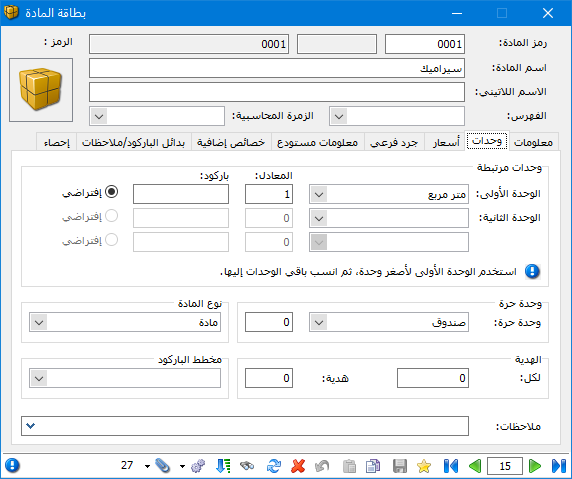
Illustration: defining an independent item unit

See: Define Items

Choose Definitions > Invoice Types > Columns and enable Independent Unit and Independent Quantity, as shown below:
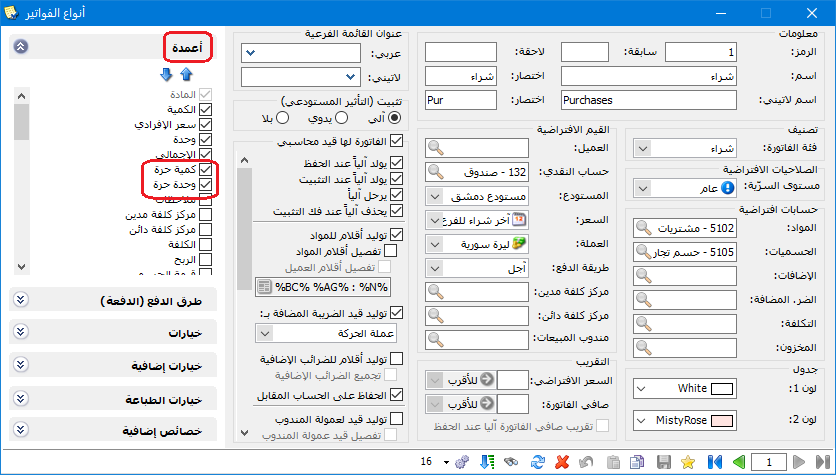
Illustration: defining an independent item unit

See: Invoice Types

In the invoice, enter square meters in Quantity and the corresponding number of boxes in Independent Quantity, as shown below:
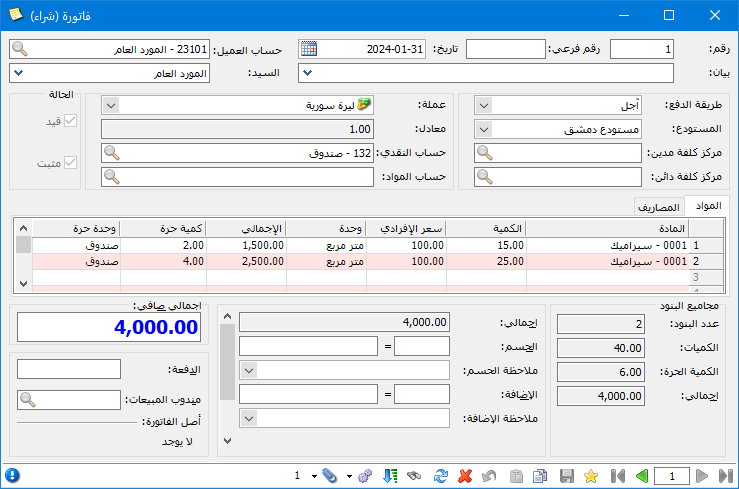
Illustration: defining an independent item unit

Request the Stocktake Report and enable Show Independent Unit, as shown below:
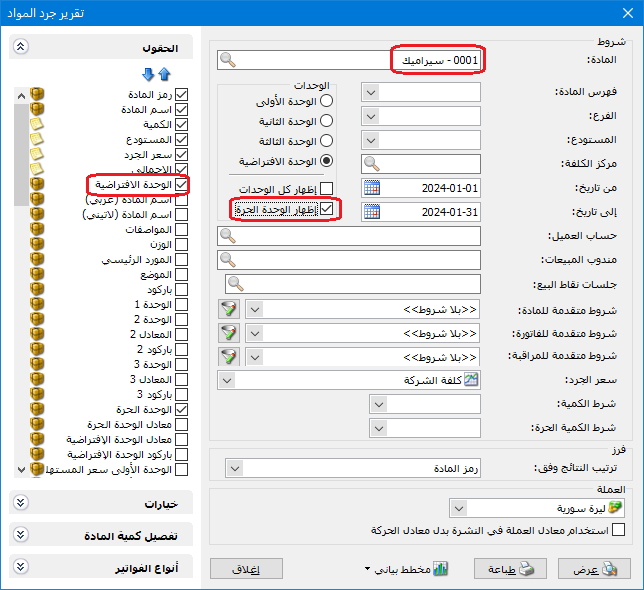
Illustration: defining an independent item unit

The report then displays ceramics stock in both square meters and boxes:
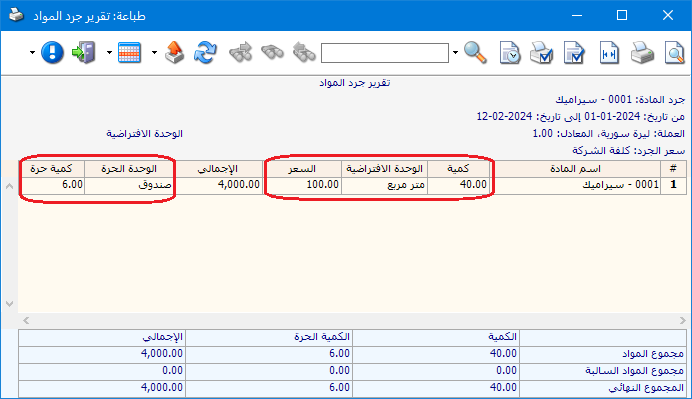
Illustration: defining an independent item unit

Define and Use Formulas for Invoice Item Quantity #

Item quantity can be entered directly as the amount sold or purchased. In some cases, it is easier to calculate that quantity through a formula.

Al Mizan .NET supports flexible quantity formulas using several fields and arithmetic operations. Advanced functions can round the result, divide it by a specified value or perform other calculations.

Consider the following example: #

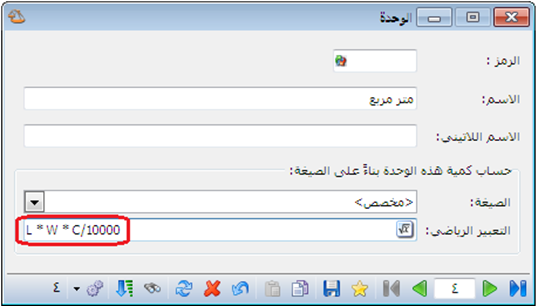
Suppose a company buys and sells marble by square meter. Area is calculated as Length × Width × Number of Pieces of the same size. The user enters those values and the software puts the result in Quantity. Define the formula through the unit record as follows:

Choose Items > Item Reference Data > Unit and define Square Meter. In Formula, select Length × Width × Independent Quantity, as shown below:
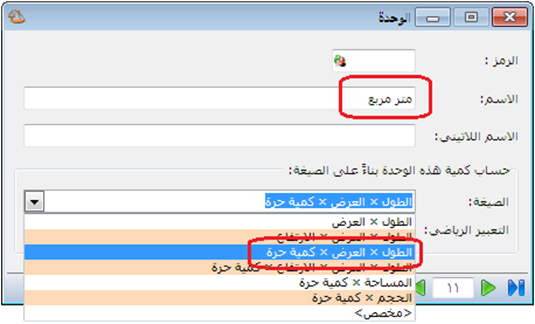
Illustration: the field permissions example

.

Modify Formulas: #

If lengths and widths are entered in centimeters but marble is sold in square meters, divide the area formula by 10,000. Choose Length × Width × Independent Quantity, then use Custom Formula to edit the Mathematical Expression and divide it by 10,000. The result is then in square meters, as shown below:

.
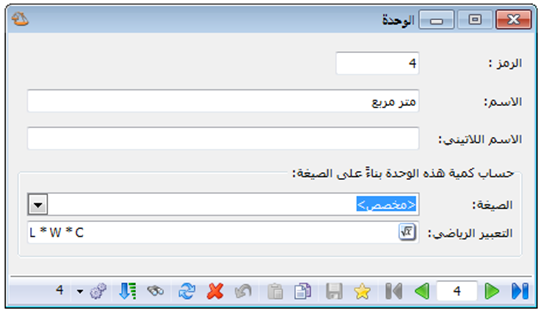
Illustration: modifying formulas

.

Define the Marble item and set its First Unit to Square Meter on the Units tab:

Enable Length, Width and Independent Quantity, representing the number of pieces, in Invoice Types:
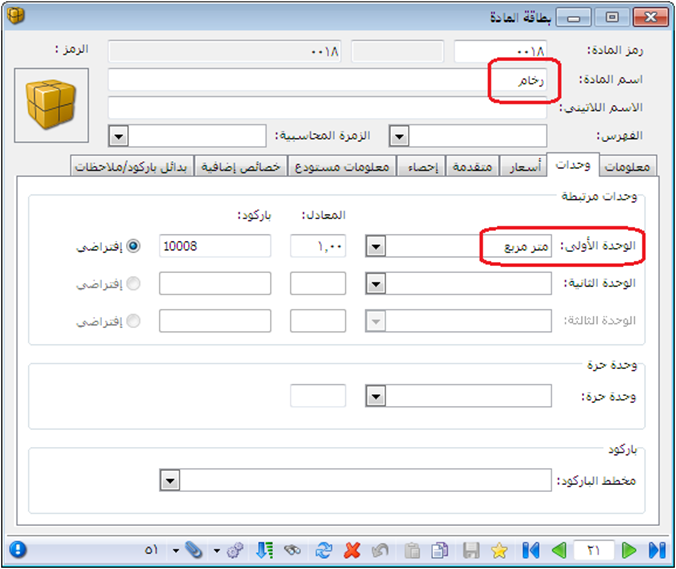
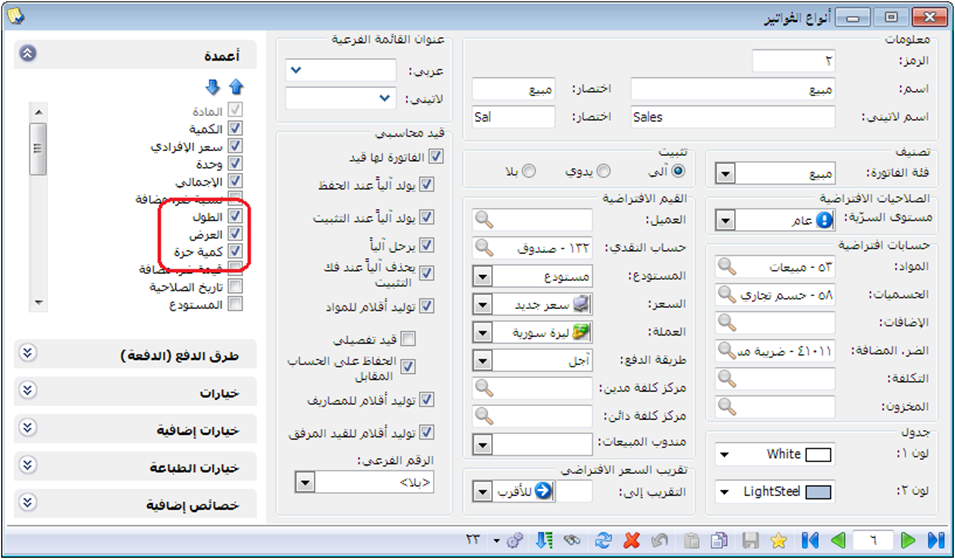
Illustration: modifying formulasIllustration: modifying formulas

When Marble is added to an invoice, enter length, width and piece count. The area is calculated automatically and inserted in Quantity:
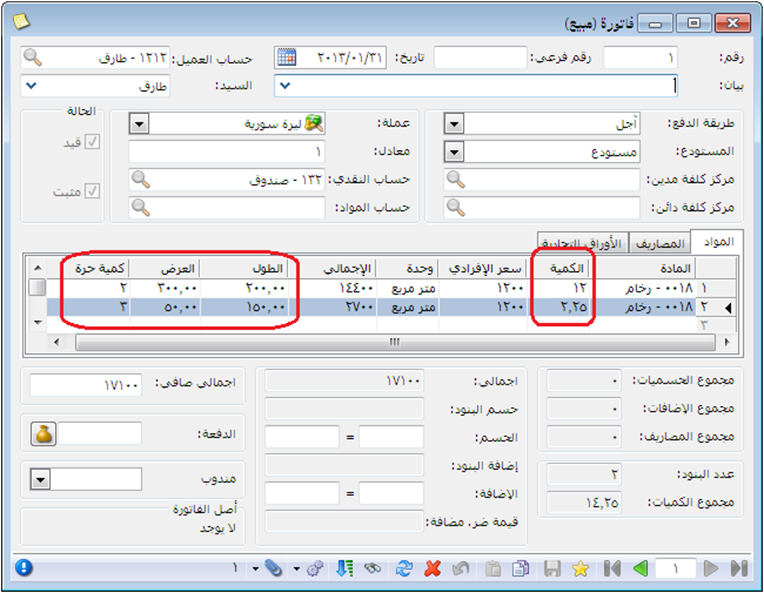
Illustration: modifying formulas

Note 1: #

The example uses a predefined formula. If you need different variables, use the button in Mathematical Expression to insert the required variables and select arithmetic operations such as addition, multiplication or division, as shown below:
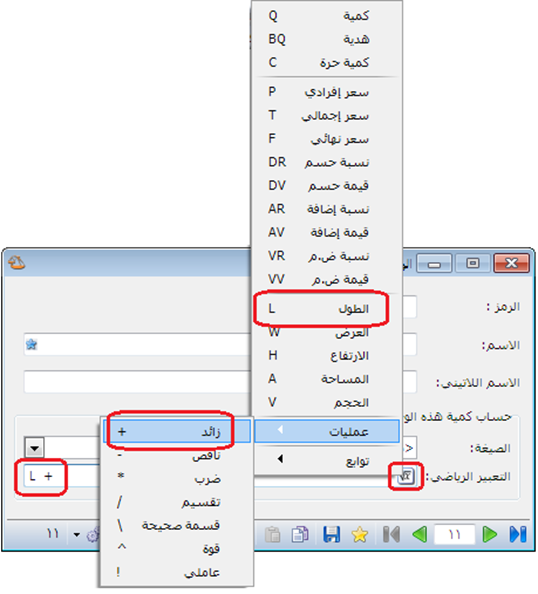
Illustration: subinventory note 1

You can also use advanced functions. For example, to enforce a minimum billed area of 0.25 square meters, use MAX with the formula result and 0.25 as its two arguments. It returns the larger value: 0.25 for a smaller calculated area, or the calculated area when larger, as shown in the unit record below:
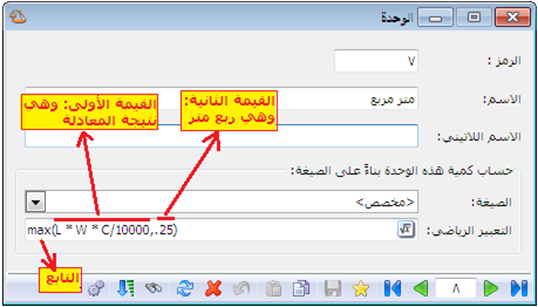
Illustration: subinventory note 1

Note 2: #

Rename Independent Quantity to Number of Pieces in General Settings > Terminology, as shown below:
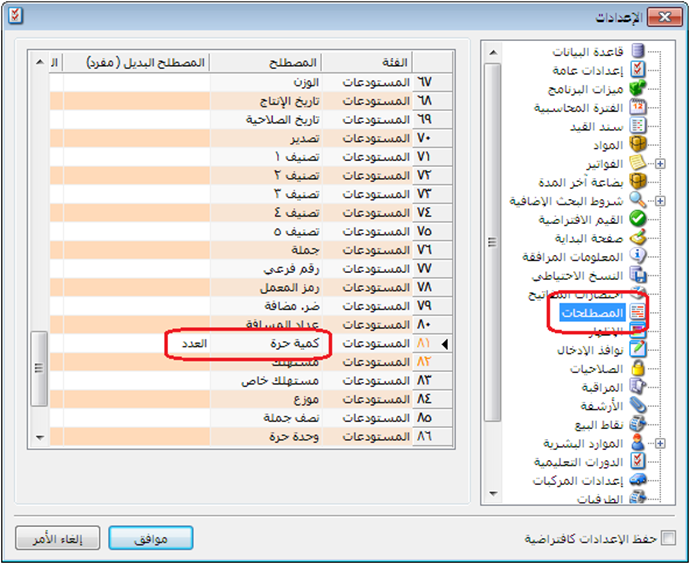
Illustration: independent unit note 2

Follow our YouTube channel

Share This Article

  • Facebook
  • X
  • LinkedIn
  • Pinterest
Could not find what you need? Contact us

How can we help you?

Updated on October 2, 2026
Configure Perpetual Inventory in Al MizanUse Item Subinventory in Invoices

Powered by BetterDocs

Contents
  • Define and Use Formulas for Invoice Item Quantity
    • Consider the following example:
    • Modify Formulas:
    • Note 1:
    • Note 2:
Mizan logo black1

Al Mizan .NET Accounting and Inventory: take the next step toward more effective business management

Quick Links

  • Knowledge Base
  • Privacy Policy (Arabic)
  • Terms and Conditions (Arabic)
  • Contact Us

Stay Informed

Get the latest news and offers from our website 

  • Abdurrahman Nafiz Gürman, No:05
    Güngören/İstanbul
  • +905360652643
  • info@hadarasoft.net
© 2026 Hadarasoft
Instagram Facebook-f Youtube
Need help? Contact us