


This report shows item quantities in warehouses. Open Item Inventory from the Reports menu or click Item Inventory on the main toolbar. The following criteria window appears:

.
Conditions: #
- Item: Select the item to inventory.
- Item Category: Select the category whose items you want to inventory.
- Branch: Select a branch to include item transactions in its warehouses.
- Warehouse: Select a warehouse to include item transactions in that warehouse.
- Cost Center: Select a cost center to inventory items allocated to that cost center.
- From Date / To Date: Specify the date range for the item transactions included in the inventory report.
- Customer Account: Select a customer account to report items sold to that customer, or a supplier account to report items purchased from that supplier.
- Sales Representative: Select a sales representative to report items from invoices associated with that representative.
- POS Sessions: Select a POS session to report items sold during that session.
- Advanced Item Conditions: Use item record fields to filter the items included. For example, to inventory items with size M, set an advanced filter where Size equals M, as shown below:
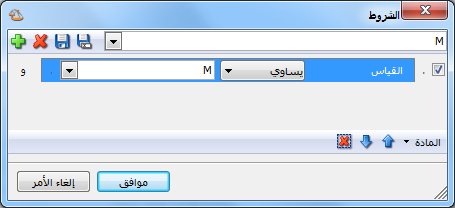
.
Advanced Conditions: #
- Advanced Invoice Conditions: Set advanced invoice filters to include only matching invoices.
- Advanced Audit Conditions: Use audit filters such as the invoice creator’s username or computer name, or the user who last modified the invoice.
Inventory Valuation Price: #
Select the price used to value item quantities. Company Cost is commonly used.
- Quantity Filter: Available operators are All, Equal To, Not Equal To, Greater Than, Greater Than or Equal To, Less Than, Less Than or Equal To, and Between. Results are filtered accordingly.
- Independent Quantity Filter: Available operators are All, Equal To, Not Equal To, Greater Than, Greater Than or Equal To, Less Than, Less Than or Equal To, and Between. Results are filtered accordingly.
Sort: #
Sort Results By: Select how to sort the report results. The available options are:
- Item Code
- Item Name
- Category Code, Then Item Name
- Quantity Ascending
- Quantity Descending
- Category Code, Then Quantity Ascending
- Category Code, Then Quantity Descending
Currency: #
Select the currency in which the report should be displayed.
Exchange Rate: Specify the rate relative to the base currency. This field is available only for a secondary currency and offers two choices:
- Use the Exchange-Rate Schedule: Retrieve exchange rates automatically from the schedule, using the rate applicable on each transaction date.
- Use a Specified Exchange Rate: Enter a rate in the field that appears and use it to display the report.
Use the Scheduled Currency Rate Instead of the Transaction Rate: Use the rate from the exchange-rate schedule instead of the original transaction rate. This option is used when requesting the report in the base currency.
Units: #
The following unit options are available:
- First Unit.
- Second Unit.
- Third Unit.
The report is displayed using the selected unit.
- Default Unit: This option uses the unit marked Default on the Units tab of the item record. It can be the first, second or third unit.
- Show All Units: This option displays quantity and price in the selected unit, together with quantities in the second and third units, as shown below:
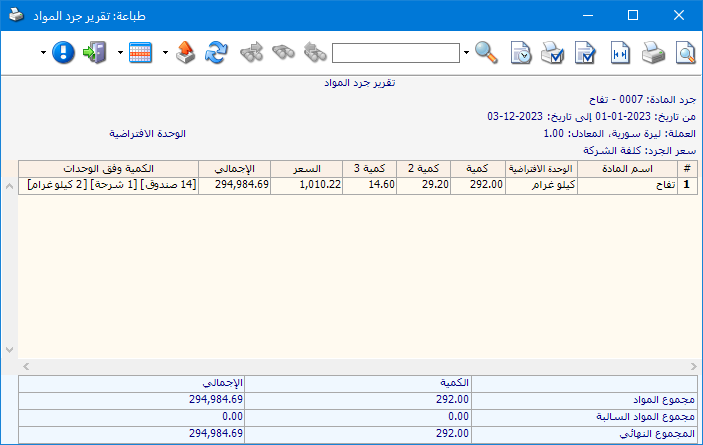
.
- Show Independent Unit: Enable this option to display warehouse quantity in the independent unit in addition to the selected standard units, as shown below:
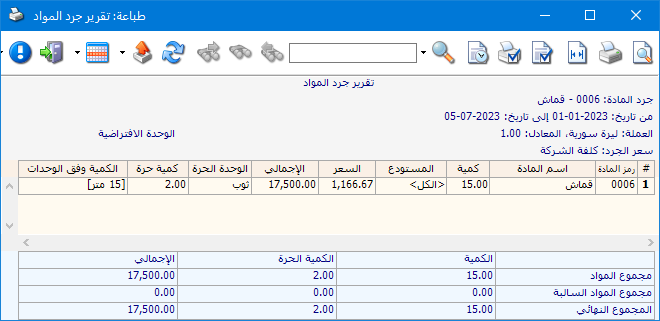
.
Fields: #
Select the columns to display in the Fields section.
Options: #
The options section contains:
- Show Sequence Number: Enable this option to display a sequential number for each item.
- Show Positive Balances: Enable this option to display items with positive balances.
- Show Negative Balances: Enable this option to display items with negative balances.
- Show Zero-Balance Items: Enable this option to include items with zero warehouse stock in the inventory report..
- Break Down by Warehouse: Enable this option and select the Warehouse field to display separate rows for each warehouse, showing the item quantity in each one, as shown below:
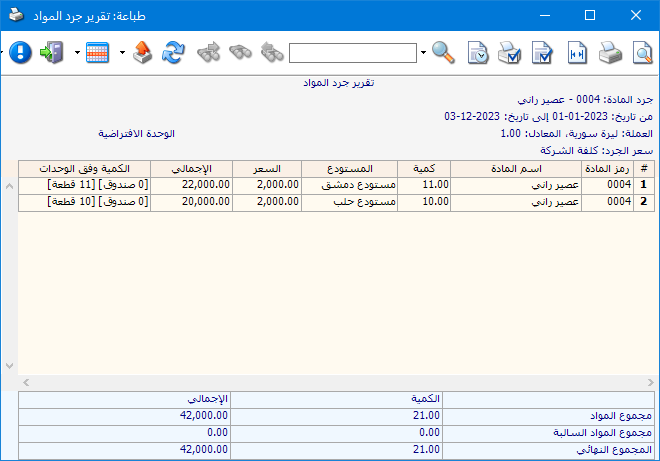
.
- Break Down Quantity from Date: Enable this option to split warehouse quantity into opening quantity, receipts and issues beginning from the From Date value. The report then appears as follows:
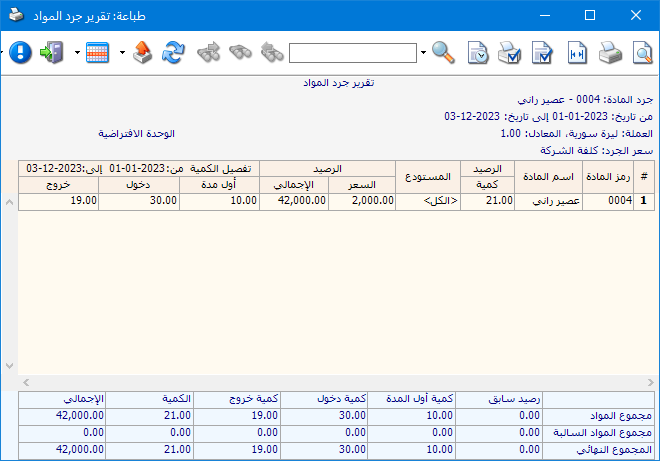
.
Display Options: #
- Show Physical Items: Enable this option to include records whose Item Type is Item, representing physical warehouse stock.
- Show Service Items: Enable this option to include records whose Item Type is Service, representing services without physical warehouse stock.
- Show Quantities OnlyEnable this option to omit item prices and the Price field. Click Display to view the quantity-only inventory report, as shown below:
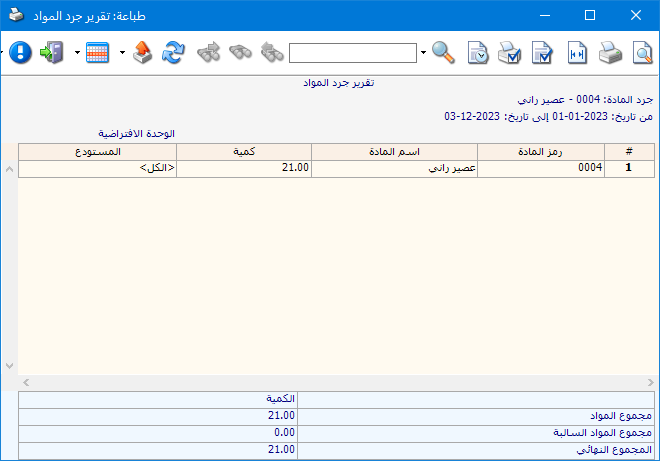
.
- Combine Item Code and Name: Combine item code and name in one report field.
- Show Only Items with Transactions from Date: Enable this option and select the starting date used to identify items with transactions.
Item Quantity Breakdown: #
- No Breakdown: Display each item without breaking its inventory down by subinventory keys.
- Use the Subinventory Fields Defined for Each Item: Break down inventory using the subinventory keys selected in the item record, such as color, size, batch, area, item class, expiry date, factory code, height, length, production date, volume or width.
- Use Custom Fields: This option lets you select subinventory keys manually rather than using those chosen in each item record. Available keys include color, size, batch, area, item class, expiry date, factory code, height, length, production date, volume and width.
Invoice Types: #
Select the invoice types whose transactions should be included in inventory calculations.
Show: #
Display the report using the preceding conditions.
Print: #
Click this button to print the final report.
Chart: #
Use this button to display inventory as a chart instead of a numeric table.
Close: #
Close the report conditions window.
Practical examples of information available from the Item Inventory report:
- Total company inventory valued at cost.
- Inventory of the Cotton item.
- Inventory restricted to positive quantities, negative quantities or both.
- Inventory in the Main Warehouse only.
- Inventory of the Clothing category only.
- Quantities sold to the customer Tareq.
- Quantities sold through the sales representative Imad.
- Clothing category inventory, broken down into opening quantities, receipts and issues.
- Inventory of physical items only, service items only or both.
- Cotton inventory broken down by warehouse, with one row per warehouse.
- Quantities purchased from the supplier Samer.
- Clothing category inventory broken down by each item’s color and size.
- Inventory of red clothing items in size 38.
- A chart of Clothing category inventory.
.


